Every shop talks about uptime, but on the floor it rarely feels like a single metric. It feels like a machine waiting on an operator who got pulled to another cell. It feels like a spindle sitting idle during lunch, or a lathe stopping because a finished part jammed in a chute that looked fine during tryout. It feels like good equipment underperforming for reasons that are frustratingly ordinary.
That is why machine tending has become such a practical entry point into CNC automation. Not because it is flashy, and not because every operation needs a robot, but because the problem it solves is usually obvious. A CNC machine makes money when it is cutting. If loading, unloading, door handling, part orientation, gauging, or operator travel is consuming more time than the process itself, automation can reclaim that lost capacity without buying another machine.
The shops that do this well are not chasing novelty. They are squeezing real output from assets they already own. A properly integrated tending cell can reduce idle time, stabilize cycle-to-cycle performance, improve part flow, and make staffing less brittle. It can also expose issues nobody wanted to see, including inconsistent part presentation, poor chip control, weak workholding, and programs that were written around human compensation rather than process discipline.
The upside is real, but so are the trade-offs. CNC automation succeeds when the details are handled with care, and those details are more mechanical and operational than most people expect.
Uptime gains start before the robot arrives
A common mistake is to think automation begins with robot selection. In practice, it starts with understanding where time is being lost. I have seen cells where management blamed low output on labor availability, only to find the larger issue was machine behavior. One horizontal machining center looked like a perfect candidate for tending until we mapped a shift and discovered the spindle was already down nearly 18 percent of the time for chip evacuation and manual air blow-off. Installing a robot without addressing that would have automated the loading task while preserving the real bottleneck.
Machine tending works best when the process has a stable center. Cycle times do not need to be short, but they do need to be predictable enough that upstream and downstream equipment can keep pace. The parts do not need to be simple, but they do need repeatable presentation, secure gripping surfaces, and workholding that can tolerate unattended operation. Operators do not need to disappear from the process, but their role changes. Instead of standing at the door every cycle, they manage exceptions, replenish material, inspect critical features, and keep multiple assets moving.
This shift matters. On many projects, the best return does not come from running one machine faster. It comes from allowing one skilled operator to supervise two or three automated assets instead of being trapped in front of one. That is a labor leverage story as much as an equipment story.
Where machine tending pays off fastest
The strongest candidates are often less glamorous than people expect. Repetitive load and unload cycles, moderate to long machining times, consistent part families, and a clear path for raw material in and finished parts out, those are the situations where uptime gains arrive fastest. High mix work can also be automated, but the engineering burden rises quickly if every product requires a different gripping strategy, stack pattern, or interface sequence.
There is a useful reality check I like to apply when evaluating a cell. If an experienced operator loads a machine in 20 seconds, but the cycle runs for 12 minutes, the robot does not need to beat the operator on pure motion to win. It needs to show up every time, cover breaks and shift changes, reduce waiting, and free labor for higher value work. That is where the cumulative hours appear.
One small job shop I worked with had two vertical machining centers producing aluminum housings. Human load time averaged about 25 seconds and machining time was just under 9 minutes. On paper, the labor savings looked modest. In practice, the automated cell added productive runtime during breaks, improved first shift consistency, and enabled a second unattended stretch in the evening. Their monthly part output climbed far more from recovered non-cutting time than from any reduction in load time.
That pattern repeats across industries. The robot is often sold as a speed tool, but in machine tending it is usually a consistency tool.
The mechanical side decides the outcome
Software gets attention because it is visible, but the mechanical design is where many automation projects are won or lost. If part handoff is awkward, if chip contamination is not managed, or if the gripper barely holds a slick turned blank, uptime will suffer no matter how clean the robot path looks on screen.
End of arm tooling deserves more thought than it usually gets. Shops sometimes focus on robot payload and reach while treating the gripper as a catalog item. That can work for simple prismatic parts, but it falls apart when parts vary in finish, temperature, orientation, or chip burden. The gripper must not only pick and place. It must tolerate the real environment of the machine.
For raw castings, that may mean compliance and enough grip margin to account for variation in parting line flash. For machined steel parts with coolant residue, jaw material and contact geometry matter more than people expect. For shafts or rings, it may be smarter to grip on a sacrificial surface or on a known turned diameter rather than trust irregular stock condition. Double grippers can shorten door-open time, but they add mass, complexity, and collision risk. Sometimes a simpler single-part tool is the better uptime choice.
I have seen elegant robotic cells kneecapped by poor end of arm tooling decisions. In one case, a two-station lathe cell repeatedly faulted because chips packed into the gripper fingers and prevented full closure on the next blank. The robot did exactly what it was told. The tooling just had nowhere for debris to go. A small redesign with relieved pockets, air assist, and more forgiving finger geometry changed the cell from fragile to dependable.
That is a recurring lesson in CNC automation. The robot usually is not the weak point. Interfaces are.
The machine tool has to cooperate
Older CNC equipment can often be automated successfully, but not all machines are equally friendly. The machine needs a reliable way to communicate cycle complete, door status, chuck or vise confirmation, alarm state, and safe conditions for entry. Sometimes this is straightforward through standard I/O. Sometimes it turns into a detective job through relays, ladder review, or aftermarket interface hardware.
Door automation is one area where shortcuts tend to cause trouble. A sticky automatic door or a slow pneumatic retrofit can quietly erase the benefits of a fast tending sequence. The same goes for part ejection. If a machine was originally set up for an operator to reach in, rotate a part by feel, clear chips with an air wand, and close the chuck based on sound and habit, that tribal knowledge must be translated into robust machine logic.
This is where HMI programming becomes more important than many buyers realize. Operators and maintenance technicians need a clear, accessible way to run the cell, recover from common faults, switch part numbers, and understand where the sequence stopped. A good human-machine interface does not try to impress. It removes ambiguity. It tells the operator whether the robot is waiting on the CNC, whether the CNC is waiting on a clamp confirm, whether the infeed is empty, and what step comes next in recovery.
Bad HMI design creates dependence on the integrator. Good HMI design creates ownership inside the plant.
The most effective screens I have seen share a few traits. They show cell state in plain language. They separate auto, manual, and maintenance functions cleanly. They guide restart after faults instead of forcing trial and error. And they expose only the controls that the user at that level actually needs.
What a reliable tending cell must handle
Before a cell is considered production-ready, it should prove it can handle the ordinary disturbances that happen every week on the floor:
Variation in raw part presentation, within the agreed process window. Chip and coolant contamination during repeated operation. Machine alarms, interrupted cycles, and controlled restart. Tool wear drift that changes clamp load, location, or unload behavior. Planned operator interactions such as replenishment, inspection, and cleanout.That list looks basic, but it separates demonstration cells from production cells. Anyone can show a robot loading ten perfect parts during a buy-off. Real value shows up when the system survives Friday afternoon conditions, a warm machine, worn jaws, mixed stock appearance, and an operator who did not attend the FAT.
Cycle time matters, but not in the way people think
Cycle time discussions around machine tending can get oddly narrow. Teams will debate whether the robot can shave three seconds off door-open time while ignoring the six minutes the machine loses each shift to waiting for material. They will optimize wrist motion and overlook the fact that finished parts are manually packed one at a time at the back of the cell.
A better way to think about this is through three layers of time. First, there is pure robot handling time, the seconds needed to enter, exchange parts, and exit. Second, there is machine dependency time, such as door movement, chuck actuation, probe checks, and spindle orientation. Third, there is support time around the cell, including tote changeover, dunnage management, operator travel, and recovery from minor stops.
The first layer is the easiest to improve and usually the least important once it is reasonable. The second layer often requires better CNC integration and machine-side optimization. The third layer is where many uptime gains hide, because poor peripheral design forces frequent interruptions.
I worked on a cell where the robot sequence was already efficient, but uptime was capped by finished-part handling. The outfeed tray filled unevenly, operators had to open the guarding more often than planned, and small restacks consumed time that never appeared in the robot program. Switching to a denser pack pattern and adding a simple visual cue for tote fullness improved sustained runtime more than any path optimization.
That kind of result is common. The robot does not live in isolation. The cell must be treated as a material flow system.
Staffing changes, and that is not a side issue
There is a temptation to frame https://garrettzjst382.opalvector.com/posts/industrial-automation-canada-what-to-know-before-upgrading-your-plant machine tending only in terms of labor reduction. Shops that do that often create resistance they do not need. On the floor, the change is usually better understood as labor reallocation and skill elevation. A good operator who used to spend hours opening a door and swapping parts can instead monitor process health, change consumables, perform checks, and keep multiple machines productive.
That does not happen automatically. If the tending cell is brittle, the operator becomes a full-time babysitter and the promised leverage disappears. If the cell is robust, the operator becomes more valuable, not less. This is especially true in shops where experienced machinists are hard to find. Automation does not remove the need for judgment. It concentrates that judgment where it matters most.
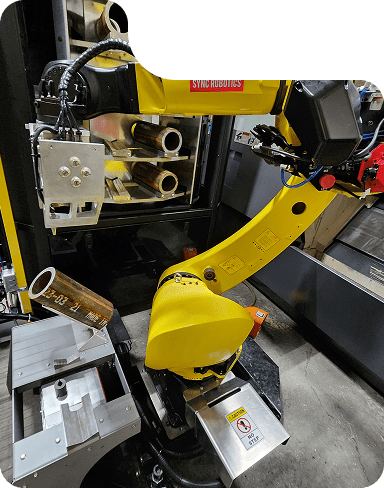

There is also a training component that should not be minimized. Maintenance needs to understand not just the robot, but the interaction between robot, machine, tooling, sensors, pneumatics, and PLC logic. Operators need clear fault recovery practices. Programmers need to respect how small machining changes can ripple into automation reliability. Cross-functional ownership is usually the difference between a cell that improves over six months and one that plateaus after launch.
Robotic welding and machine tending often belong in the same conversation
At first glance, robotic welding and CNC automation seem like separate investments. One joins material, the other tends machining processes. On the floor, though, they often solve the same business problem: too much value tied up in manual, repetitive work that limits throughput and consistency.
Shops fabricating welded assemblies often machine features afterward. When robotic welding stabilizes weld placement and heat input, the downstream machining process becomes easier to fixture and more predictable. The reverse is also true. If machined components are loaded consistently and produced with better uptime, welding cells downstream receive steadier flow and can be staffed more intelligently.
The lesson is that automation choices should not be made in isolation by department. A CNC automation project may alter queue time, inspection strategy, pallet movement, and staffing in adjacent operations. The best plants look at how value moves across the whole process, not just at one machine enclosure.
What to ask before approving a project
A sensible machine tending project is rarely about whether automation is good in theory. It is about whether this specific process is ready, whether the interfaces are honest, and whether the economics survive contact with daily production. Before moving ahead, decision-makers should be able to answer a few grounded questions:
What is the machine’s actual non-cutting time by shift, not the assumed value? How stable is raw part presentation, and who owns that consistency? Can the machine expose the signals needed for safe, reliable automation? What does recovery look like after a common fault at 2:00 a.m.? Who inside the plant will maintain and improve the cell after launch?Those questions sound simple, but they force clarity. If nobody knows true idle time, expected uptime improvement may be inflated. If part presentation is inconsistent, the gripper problem may actually be a receiving or upstream process problem. If no one owns long-term support, the cell may run well for a month and then slowly degrade.
The economics are stronger when you count the right things
Return on investment calculations often start with direct labor, because it is easy to model. One operator, one machine, one wage rate, one shift. That view is too narrow for most tending cells.
Recovered spindle hours matter. Improved schedule confidence matters. Reduced dependence on hard-to-staff shifts matters. Better consistency in load orientation, clamp timing, and handoff matters. Even quality can improve when automation removes subtle human variation from repetitive tasks. Not every project will deliver all of those benefits, but many deliver more than labor savings alone.
There are costs that deserve equal honesty. The cell will require maintenance support. Changeovers may demand more engineering discipline than before. Spare parts and sensor strategies matter. Floor space has a value. Safety reviews take time. And some jobs simply do not justify the effort, especially if demand is sporadic or the process changes weekly.
Strong automation decisions are rarely ideological. They are selective. Shops that succeed with machine tending do not try to automate everything. They pick the work where consistency, volume, and runtime opportunity intersect.
Uptime is a systems result
When people first look at a robot tending a CNC machine, they tend to focus on the motion. The arm moves, the door opens, the part changes hands. It is visible, precise, satisfying. But the real uptime gain comes from all the quiet conditions around that motion being engineered properly.
It comes from end of arm tooling that still grips securely when coolant has coated the part for the thousandth time that week. It comes from HMI programming that lets a second-shift operator recover confidently without a phone call. It comes from a chuck confirm signal that tells the truth, an outfeed design that does not force needless interruptions, and machine logic that cooperates instead of fighting the cell.
That is why the best machine tending projects feel almost uneventful once they are in production. There is no drama, just more cutting time, fewer pauses, steadier output, and a team that can spend its attention where skill actually matters.
For shops trying to boost uptime, that is the point. Not a robot for its own sake, but a more reliable way to turn machine capacity into shipped parts.
Sync Robotics Inc. — Business Info (NAP)
Name: Sync Robotics Inc.Address: 2-683 Dease Rd, Kelowna, BC V1X 4A4
Phone: +1-250-753-7161
Website: https://www.syncrobotics.ca/
Email: [email protected]
Sales Email: [email protected]
Hours:
Monday: 8:00 AM – 4:30 PM
Tuesday: 8:00 AM – 4:30 PM
Wednesday: 8:00 AM – 4:30 PM
Thursday: 8:00 AM – 4:30 PM
Friday: 8:00 AM – 4:30 PM
Saturday: Closed
Sunday: Closed
Service Area: Kelowna, British Columbia and across Canada
Open-location code (Plus Code): VHWR+PQ Kelowna, British Columbia
Map/listing URL: https://maps.app.goo.gl/xwtV2wEu8ZuKH3se8
Embed iframe:
Socials (canonical https URLs):
LinkedIn: https://www.linkedin.com/company/syncrobotics/
Instagram: https://www.instagram.com/syncrobotics/
Facebook: https://www.facebook.com/syncrobotics/
https://www.syncrobotics.ca/
Sync Robotics Inc. is an industrial robot and controls integration company based in Kelowna, British Columbia.
The company designs and deploys automation solutions for manufacturing operations across Canada.
Services include industrial robotics integration, controls integration, automation system design, deployment support, and related manufacturing automation solutions.
Sync Robotics Inc. is located at 2-683 Dease Rd, Kelowna, BC V1X 4A4.
To contact Sync Robotics Inc., call +1-250-753-7161 or email [email protected].
For sales inquiries, email [email protected].
Hours listed are Monday to Friday 8:00 AM–4:30 PM, with Saturday and Sunday closed.
For directions and listing details, use the map listing: https://maps.app.goo.gl/xwtV2wEu8ZuKH3se8
Popular Questions About Sync Robotics Inc.
What does Sync Robotics Inc. do?Sync Robotics Inc. designs and deploys industrial robot and controls integration solutions for manufacturing operations.
Where is Sync Robotics Inc. located?
Sync Robotics Inc. is located at 2-683 Dease Rd, Kelowna, BC V1X 4A4.
Does Sync Robotics Inc. serve clients outside Kelowna?
Yes—Sync Robotics Inc. is based in Kelowna, British Columbia and serves clients across Canada.
What are Sync Robotics Inc.’s hours?
Monday–Friday: 8:00 AM–4:30 PM; Saturday and Sunday closed.
How can I contact Sync Robotics Inc.?
Phone: +1-250-753-7161
General Email: [email protected]
Sales Email: [email protected]
Website: https://www.syncrobotics.ca/
Map: https://maps.app.goo.gl/xwtV2wEu8ZuKH3se8
LinkedIn: https://www.linkedin.com/company/syncrobotics/
Instagram: https://www.instagram.com/syncrobotics/
Facebook: https://www.facebook.com/syncrobotics/
Landmarks Near Kelowna, BC
1) Kelowna International Airport2) UBC Okanagan
3) Rutland
4) Orchard Park Shopping Centre
5) Mission Creek Regional Park
6) Downtown Kelowna
7) Waterfront Park